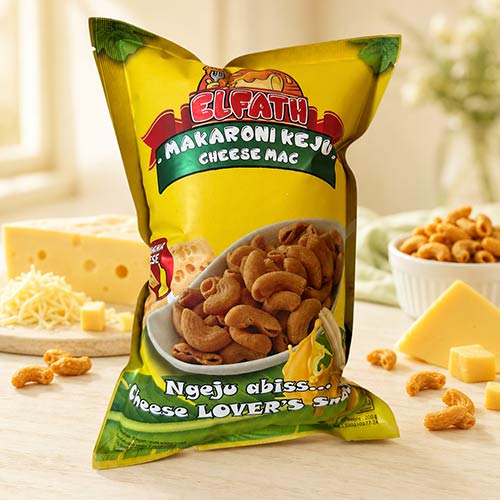
If you are screening an Indonesian gluten-free snack supplier for the first time, the hardest part is rarely the product. Indonesia has an enormous small-batch snack industry, and samples usually taste good. The difficulty is verifying that a workshop-scale producer can document what it makes, keep a recipe stable across months, and load a container without you flying in to supervise. This guide walks through the checks that actually matter, in the order a buyer normally needs them.
We write from the perspective of a Central Java producer of cheese-coated macaroni snacks, so some examples are specific to that category. The framework, though, applies to most dry Indonesian snacks: crackers, coated peanuts, cassava chips, extruded corn snacks.
First, define what “gluten-free” has to mean in your market
This is where most sourcing conversations go wrong. In Indonesia, “gluten-free” is often used descriptively: the recipe simply contains no wheat. In the EU, the United States, Australia and several Gulf markets, it is a regulated claim tied to a threshold and, in practice, to testing and cross-contact controls.
So separate two questions when you talk to a factory:
- Is the formulation free of gluten-containing ingredients? For macaroni snacks, that means checking what the pasta base is made from. Corn-based or rice-based pasta is naturally gluten-free; durum wheat pasta is not. Also check seasoning carriers, maltodextrin sources, soy sauce powders and anti-caking agents.
- Can the claim be defended on a label? That needs allergen mapping of the whole line, a cleaning validation between runs if wheat products share equipment, and periodic lab results from an accredited laboratory.
Ask for the ingredient breakdown of every component, including sub-ingredients of the seasoning blend. A supplier that answers only “yes, gluten free” without documents is not necessarily dishonest, but you will be the one carrying the regulatory risk.
Certification: what Indonesian producers typically hold
You will meet three documents constantly, and they answer different questions.
| Document | What it covers | Why a buyer cares |
|---|---|---|
| Halal certification | Ingredients, processing aids, and facility compliance under Indonesia’s halal system | Mandatory for domestic circulation and essential for Muslim-majority import markets |
| BPOM distribution permit | Product registration with the Indonesian food and drug authority | Signals a formal, inspected facility rather than an unregistered home kitchen |
| HACCP | Hazard analysis and documented critical control points | The closest thing to a food-safety baseline you can audit remotely |
These are the certifications ELFATH holds, and they are a reasonable minimum to demand from any Indonesian gluten-free snack supplier. Note what they do not cover: they are not a gluten-free certification scheme, and they are not BRCGS or IFS. If your retail customer requires a GFSI-benchmarked standard, ask early whether the producer is willing to work toward it, and accept that this takes time and investment.
Two more documents belong on your list before the first shipment: a Certificate of Free Sale (or health certificate) and a Certificate of Origin, which may matter for preferential tariffs depending on your country’s trade agreements with Indonesia.
Shelf life and the climate problem
Cheese-coated snacks are fat-bearing and hygroscopic. In tropical humidity, the two failure modes are rancidity of the oil and moisture pickup that kills crispness. Neither shows up in a sample you eat the week it arrives; both show up on a retail shelf four months later.
Practical questions to ask:
- What is the declared shelf life, and was it established by accelerated testing, real-time testing, or estimation?
- What is the packaging structure? Metallised laminate performs far better than plain PP for oxygen and light barrier.
- Is nitrogen flushing available? For sea freight to distant markets, this is worth discussing.
- Are chemical preservatives used? Some producers, including ELFATH, deliberately avoid them, which is a selling point in clean-label markets but tightens your packaging and logistics requirements.
Ask for a retention sample from a batch produced several months ago and taste it. This single test tells you more than any specification sheet.
MOQ, capacity and the honest limits of a small producer
Indonesian snack producers in this segment are typically SMEs. That has advantages: flavour development is fast, minimums are flexible, and you can often get a mixed pallet. It also has real limits, and a good supplier will say so.
Expect MOQ to be negotiated in cartons rather than containers for a first order, especially if you want a trial before committing. For established, unbranded or lightly branded shipments, buyers usually think in terms of an LCL consignment first, then a full container once sell-through is proven. Because dry snacks are voluminous and light, you will almost always cube out before you weigh out: the container fills up long before you reach the weight limit. Plan your costing around volume, not tonnage, and ask the producer for exact carton dimensions and cartons-per-pallet so you can model loading properly.
Two limits to raise directly: private label and custom packaging. Printed film normally carries its own minimum from the film printer, separate from the product MOQ. If you need your own artwork, that conversation should happen at the start, not after you approve samples.
Incoterms and who does what
Smaller Indonesian producers are generally comfortable with FOB from Semarang, Tanjung Emas, or Tanjung Priok in Jakarta, sometimes FCA at the factory. Some will quote EXW and let your freight forwarder handle everything, which is often the smoothest arrangement when the producer has limited export experience. Do not assume CIF or DDP is available; if a producer offers it without a track record, ask who is actually arranging the documents.
A workable division of labour for a first shipment:
- You appoint an Indonesian freight forwarder or use your own agent’s local partner.
- The producer handles production, export cartons, palletising, and factory-gate loading.
- The forwarder handles customs clearance, booking, and the bill of lading.
- You confirm in writing which certificates must accompany the shipment, well before the cut-off.
Realistic lead times
For a made-to-order dry snack, budget roughly two to four weeks for production once artwork and specifications are frozen, plus one to two weeks for export documentation and booking, plus ocean transit. Add buffer around Ramadan and Eid, when Indonesian food demand peaks domestically and staff take extended leave, and around Chinese New Year, when regional shipping tightens. If a producer promises a materially shorter cycle than this, ask what part of it they are skipping.
How to run a sensible trial
Start with a courier sample of several flavours, tasted blind if possible against whatever you currently stock. Then order a small commercial quantity of two or three SKUs only. Resist the temptation to launch nine flavours at once; retail shelves punish fragmented ranges, and you learn nothing about which flavour actually sells. Chocolate-cheese or matcha-cheese profiles, for example, perform very differently by market than plain cheese or barbecue.
Finally, judge the supplier by how they answer inconvenient questions. A producer who admits they have not yet done real-time shelf-life testing, or that a certification is still in progress, is easier to work with than one who says yes to everything.
ELFATH Makaroni Keju has produced cheese macaroni snacks in Kaligondang, Purbalingga, Central Java since 2017, using real cheddar rather than cheese flavouring, in nine flavours and two pack formats. The products are gluten-free by formulation and carry halal, BPOM and HACCP documentation. Most of our volume goes to Indonesian resellers and retail, so export enquiries are handled case by case and we would rather talk through your market’s requirements honestly than overpromise. You can see the range on our product page, read our background on the about page, or reach the team through our contact page.
Frequently asked questions
Are Indonesian macaroni cheese snacks genuinely gluten-free?
It depends entirely on the pasta base. Snacks made from corn or rice pasta are gluten-free by formulation, while durum wheat macaroni is not. ELFATH's macaroni cheese is gluten-free, but as a buyer you should still request the full ingredient breakdown, including seasoning sub-ingredients, and confirm what your own market requires before printing a gluten-free claim on a label.
What certifications should I ask an Indonesian snack supplier for?
At minimum, halal certification, a BPOM distribution permit, and HACCP. These show the facility is registered and operates with documented food-safety controls. For export you will usually also need a certificate of free sale or health certificate and a certificate of origin, and if your retail customer demands a GFSI-benchmarked standard such as BRCGS, ask about that separately and early.
What is a realistic minimum order for importing Indonesian snacks?
Most SME producers negotiate first orders in cartons rather than full containers, so an LCL trial shipment is common before scaling to FCL. Because dry snacks are light and bulky, your container will fill on volume long before it reaches the weight limit, so ask for carton dimensions and cartons per pallet when you plan. Custom printed packaging usually carries its own separate minimum from the film printer.
Tinggalkan Balasan