If you are evaluating cassava snack export from Indonesia, the first question is rarely about flavour. It is about what the product looks like after six weeks in a steel box crossing the equator. Sea freight from Tanjung Emas or Tanjung Priok to Europe, the Middle East or North America means 25 to 45 days at sea, plus port handling, customs and inland trucking. Snacks that taste excellent at the factory gate can arrive stale, soft or reduced to crumbs.
Cassava-based and starch-based fried snacks — a family that includes tapioca crackers, cassava chips, and fried wheat-tapioca macaroni snacks — happen to be unusually well suited to that journey. The reasons are physical, not marketing. Understanding them helps you write a better specification and ask sharper questions of any supplier.
Low water activity is the main reason
Spoilage needs available water. Fried starch snacks come out of the fryer with very little of it left, and a low water activity means mould and bacteria have nothing to work with. That is why this category typically carries a shelf life measured in months without chemical preservatives, and why it does not need cold chain or temperature-controlled containers.
The practical consequence for an importer: a standard dry container is enough. You are not paying for reefer space, and you are not exposed to the risk of a refrigeration failure mid-voyage. The risk profile shifts from microbiological to physical — moisture ingress and breakage — and both are manageable through packaging and stowage.
Starch structure resists softening better than you would expect
Cassava starch fries into a rigid, aerated matrix. It is brittle, which sounds like a disadvantage, but brittleness comes with a useful property: the snack either stays crisp or it does not, and the transition depends almost entirely on how much moisture crosses the barrier film. There is no slow, gradual sogginess the way there is with baked goods that still hold residual water inside.
Compare that with snacks that carry more moisture or more free sugar. Those tend to migrate internally — moisture moves from a wetter component to a drier one, and the drier component loses its bite even inside a perfectly sealed bag. Single-texture fried starch snacks avoid that problem simply because there is nothing to migrate from.
Where the real risks sit
Being a good traveller is not the same as being invulnerable. Three things genuinely go wrong on long-haul routes.
Container heat and oil oxidation
A container parked on a Middle East quay in the afternoon can reach temperatures well above ambient. Heat accelerates the oxidation of frying oil, which produces rancid, cardboard-like off-notes long before anything becomes unsafe. This is the single most common reason a fried snack arrives disappointing rather than spoiled.
What reduces it: fresher frying oil with disciplined turnover at the factory, a barrier film with a real oxygen barrier rather than plain polypropylene, and stowage away from the container door and roof. Ask your supplier how they manage frying oil rotation. A vague answer is itself an answer.
Moisture ingress at the seal
Most failures are not film failures; they are seal failures. A pinhole from a stray flake caught in the sealing jaw, or a weak seal from a machine running too fast, lets humid air in slowly for a month. Metallised or aluminium-laminate film with a nitrogen or air cushion inside the pack gives you the best odds. For long-haul, insist on a secondary barrier — a lined master carton or a shrink-wrapped inner bundle — so that one compromised primary pack does not sit exposed for weeks.
Breakage under stack pressure
Brittle snacks break when cartons deform. Nine tiers high in a container, the bottom carton carries everything above it, and humidity softens corrugated board, reducing its compression strength. Specify a board grade suited to tropical humidity, keep carton height modest so the stack is short, and use pallets if your warehouse can handle them. Palletised loads lose some volume efficiency but arrive far tidier.
How the category compares for long-haul freight
| Snack type | Long-haul suitability | Main risk |
|---|---|---|
| Fried cassava/tapioca crackers, chips | High | Breakage, oil oxidation |
| Fried starch macaroni snacks | High | Breakage if seasoned coating is heavy |
| Nut-based snacks | Medium | Rancidity, aflatoxin controls |
| Chocolate-coated snacks | Low without reefer | Bloom, melt above roughly 30 C |
| Soft baked goods, filled cakes | Low | Mould, texture loss |
Practical checks before you commit
- Ask for a shipping trial, not just a courier sample. A sample flown by air in five days tells you nothing about week five. Request a small carton sent by sea, or ask whether the supplier has accelerated shelf-life data.
- Confirm remaining shelf life on arrival. Many retailers require a minimum proportion of shelf life left at delivery. Work backwards: production date, plus consolidation, plus transit, plus clearance. If the margin is tight, the answer is more frequent smaller shipments, not a longer claim.
- Check the certification stack. Halal, a national food authority registration such as BPOM in Indonesia, and HACCP cover most import documentation questions. You will also usually need a certificate of origin, health certificate, packing list and full ingredient and nutrition data in your market’s format.
- Agree Incoterms early. FOB Semarang or FOB Jakarta is the common starting point for Indonesian snacks; CIF suits buyers without a freight forwarder. EXW works only if you have a local agent who can handle export documentation.
- Discuss MOQ honestly. Snacks are light and bulky, so a 20-foot container fills up by volume long before weight. For a first order, mixed-flavour LCL is often more sensible than forcing a full container of one SKU that has not been tested in your market.
- Set a damage protocol. Photographs at unloading, a stated tolerance for breakage, and who bears the cost. Getting this in writing before shipment prevents most disputes.
Lead time realities
For a supplier of this size and category, plan roughly two to four weeks for production and packing after artwork and specifications are frozen, longer if the packaging film has to be printed to your design. Add booking and consolidation time before the vessel sails. Ramadan, Idul Fitri and the year-end period compress capacity across Indonesian food manufacturing, so shift your order forward if your season falls after those windows.
Also be realistic about flavour. Indonesian cheese, chilli and barbecue profiles are calibrated for local palates. Sweeter or saltier than your market expects is common, and adjusting a seasoning blend is a development conversation, not a one-email change. Ask for the closest existing variant first and taste before requesting reformulation.
Where ELFATH fits
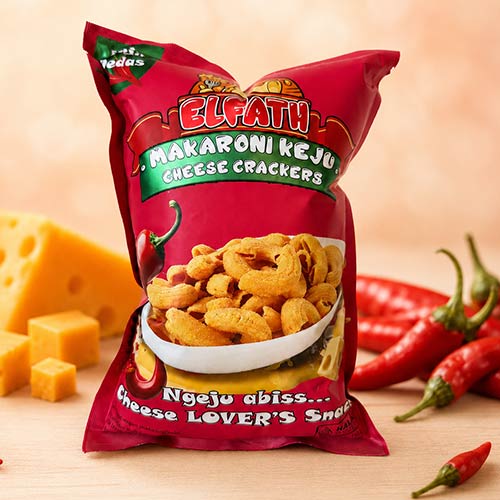
ELFATH Makaroni Keju makes fried cheese macaroni snacks in Kaligondang, Purbalingga, Central Java, using real cheddar cheese rather than cheese-flavoured powder, without chemical preservatives, and gluten free. The line holds Halal, BPOM and HACCP certification, and the product sits squarely in the low-moisture category described above — which is why it handles distribution well. Our routine business is domestic, supplying hundreds of resellers across Indonesia, so an export enquiry is a conversation rather than a catalogue order: we will be direct with you about carton specifications, packaging options and realistic timing. You can review the nine flavour variants on our product page, read how we started on our about page, or reach the team through our contact page with your destination market, target volume and preferred Incoterm.
Frequently asked questions
Berapa lama camilan berbahan cassava bertahan saat dikirim lewat laut?
Camilan starch goreng dengan kadar air rendah umumnya punya masa simpan berbulan-bulan, jadi pelayaran 30 sampai 45 hari masih aman selama kemasannya kedap. Yang perlu dihitung adalah sisa masa simpan saat barang tiba, karena banyak retailer mensyaratkan proporsi minimum. Selalu minta data masa simpan resmi dari pemasok, bukan perkiraan.
Apakah camilan keju perlu kontainer berpendingin untuk ekspor?
Tidak. Camilan goreng berbahan tepung dan keju kering cukup dikirim dengan kontainer kering biasa karena risikonya bukan mikrobiologis melainkan kelembapan dan pecah. Yang perlu diperhatikan adalah panas di dalam kontainer yang bisa mempercepat ketengikan minyak, sehingga film kemasan berpenghalang oksigen dan penempatan muatan menjadi penting.
Apakah ELFATH Makaroni Keju bisa melayani pembeli dari luar negeri?
Bisnis utama ELFATH saat ini adalah pasar domestik dengan ratusan reseller di Indonesia, jadi permintaan ekspor ditangani sebagai diskusi kasus per kasus. Produk sudah bersertifikat Halal, memiliki izin edar BPOM dan menerapkan HACCP. Silakan hubungi tim melalui halaman kontak dengan menyebutkan negara tujuan, perkiraan volume, dan Incoterm yang Anda inginkan.
Tinggalkan Balasan