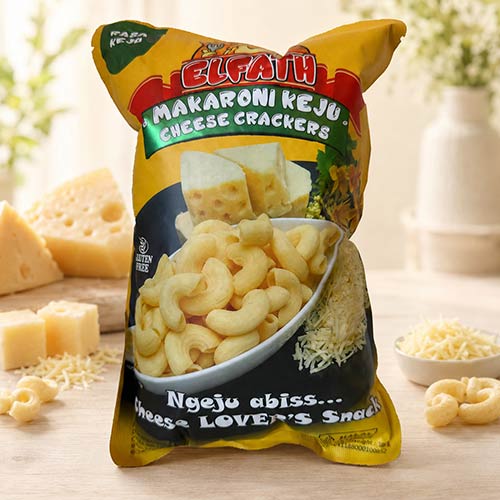
The single most useful thing to understand about snack container loading from Indonesia is this: you will almost never reach the weight limit. Fried macaroni, extruded corn snacks, crackers and cassava chips are mostly air by volume. A container packed floor to ceiling with finished snack cartons will often weigh a fraction of what the box is rated to carry. Your shipment cubes out, it does not weigh out. Every planning decision — carton size, inner count, pallet or no pallet, MOQ — follows from that one fact.
This guide walks through the arithmetic step by step, using cubic metres rather than guesswork, so you can talk to an Indonesian manufacturer in numbers both sides can verify before anything is produced.
Start with usable container volume
Nominal internal volume and usable volume are different things. Corner posts, door frames, ventilation gaps and the simple fact that carton dimensions rarely divide evenly into container dimensions all eat space. As a working rule, plan on filling roughly 85 to 90 per cent of nominal volume when floor loading, and less when palletised.
| Container | Approx. internal volume | Realistic snack load (floor loaded) |
|---|---|---|
| 20 ft dry | about 33 m³ | roughly 28–30 m³ of cartons |
| 40 ft dry | about 67 m³ | roughly 57–60 m³ of cartons |
| 40 ft high cube | about 76 m³ | roughly 65–68 m³ of cartons |
For light snacks, the 40 ft high cube is usually the most efficient unit per shipment, because the extra height costs you almost nothing in weight but adds real volume. If your market is still small, an LCL consolidation is more honest than half-filling a 20 ft box.
Carton maths, step by step
Work in this order and the numbers stay clean.
1. Fix the retail unit
Start from the pack the shopper picks up. A 185 gram family pack of macaroni snack is a pillow pack full of trapped air; it does not compress. Measure it lying flat, gently settled, not squeezed. Note the length, width and the honest thickness — the thickness is where estimates go wrong most often.
2. Decide the inner count
Common inner counts are 12, 20 or 24 pieces per master carton, sometimes grouped into inner bags of 6 or 10 so a retailer can break bulk without opening everything. More inners per carton means fewer cartons and less corrugated board per tonne, but heavier handling and more crushing risk at the bottom of the stack.
3. Calculate carton CBM
Use the external carton dimensions in metres and multiply length × width × height. A carton measuring 0.50 × 0.35 × 0.40 m is 0.07 m³. Divide your usable container volume by that figure and you have the theoretical carton count: about 28 m³ ÷ 0.07 m³ = 400 cartons in a 20 ft.
4. Convert to pieces and to weight
Multiply cartons by inner count for total retail units. Then multiply cartons by gross carton weight to sanity-check the total. If the total is far under the container payload — which for snacks it will be — you have confirmed you are volume-driven, and every centimetre of wasted carton height is money.
5. Re-run with a second carton size
Ask the factory to quote two carton formats. Shaving 3 cm off carton height because the pillow packs were stacked in two layers of ten instead of a loose jumble can lift the container count by a meaningful percentage. This is the cheapest optimisation available to you and it costs one email.
Pallets or floor loading?
For low-density snacks going to a market with manual unloading capacity, floor loading wins on volume. Pallets consume roughly 15 cm of height per tier plus gaps between stacks, and with tall light cartons that can cost you a full layer.
- Floor loaded: maximum cubic efficiency, slower discharge, more handling of individual cartons, higher risk of carton scuffing at destination.
- Palletised: faster discharge, better for distribution centres that refuse loose cargo, easier to count, but fewer cartons per container. Check whether your market requires heat-treated wood (ISPM 15) or accepts plastic pallets.
If your buyer is a supermarket DC, ask them first. Some will reject a floor-loaded container outright, and discovering that after the box is sealed in Semarang is an expensive lesson.
Stacking, crush and the tropical reality
Snack cartons are structural only if the product inside supports them, and puffed snacks support nothing. The carton wall does all the work. Points worth writing into your specification:
- Corrugated grade appropriate for the stack height you actually plan — double wall for the lower tiers if you stack high.
- A stated maximum stack height, marked on the carton, and honoured during loading.
- Nitrogen flush or at minimum a well-sealed pillow pack, because a bag that loses its air cushion becomes a bag of crumbs.
- Silica or desiccant strategy discussed openly. Sea freight through the tropics means condensation; container liner bags or desiccant poles are common for hygroscopic foods.
- Loading in dry weather, and photographs of the loading process shared before the doors close.
Ask for a drop test and a compression test result on the finished master carton. Reputable Indonesian manufacturers either have this or will run it if you request it.
Shelf life against transit time
Sea freight from Tanjung Priok or Tanjung Emas to the Middle East, Australia or East Asia is a matter of weeks; to Europe or the US west coast, longer, and transhipment adds unpredictability. Then add customs clearance, your own warehousing and the retailer’s minimum remaining shelf life at delivery — many chains demand two thirds or three quarters of total shelf life on arrival.
Do the subtraction before you commit. If the product’s shelf life is short relative to the lane, air freight for a first trial order, or a smaller and more frequent LCL rhythm, is the sane answer even though the freight cost per kilo is worse. Snacks made without chemical preservatives sit at the shorter end of the range, which is a trade-off worth accepting knowingly rather than discovering at the port.
MOQ, lead time and the first order
MOQ for Indonesian snack manufacturers is usually expressed in cartons or in production batches, not in containers. A first order rarely needs to be a full container. A sensible sequence looks like this:
- Samples by courier, tested for taste, texture and pack integrity.
- A small LCL or air trial shipment to test customs classification, labelling compliance and actual shelf performance.
- A first FCL once repeat orders are visible.
On Incoterms, FOB Semarang or FOB Tanjung Priok is the common starting point and keeps freight control with you. EXW works if you already have a reliable Indonesian forwarder. CIF is simpler for a first-time importer but means less visibility on what freight actually cost. Agree the term, the named port and who books the container before production starts — not after.
On lead time, plan for ingredient sourcing, production, packaging, certificate and document preparation, trucking to port and the vessel cut-off. Ask the factory for each step separately rather than a single vague total, and ask what happens to the schedule around Ramadan and Idul Fitri, when Indonesian production and trucking both slow down.
Documents that travel with the box
Get the paperwork list agreed at the same time as the carton spec: commercial invoice, packing list with carton dimensions and CBM stated, bill of lading, certificate of origin, halal certificate, and health or free-sale certificates if your market requires them. A packing list that states real carton dimensions is also your own audit trail — it lets you verify after the fact whether the loading plan was followed.
ELFATH Makaroni Keju produces cheese macaroni snacks in Kaligondang, Purbalingga, Central Java, in family packs and mini packs across nine flavour variants, with halal, BPOM and HACCP certification in place. Most of our volume today goes to domestic resellers across Indonesia, so export enquiries are handled case by case rather than from a standing container programme — if you want to run the carton maths for a specific market, get in touch with your target format and destination and we can work through the numbers honestly, including telling you if the volume does not yet justify a full container. Background on the company is on our about page.
Frequently asked questions
Berapa CBM muatan camilan dalam kontainer 20 ft?
Kontainer 20 ft memiliki volume internal sekitar 33 m3, tetapi untuk muatan karton camilan yang dimuat lepas (floor loaded) rencanakan sekitar 28 sampai 30 m3 yang benar-benar terpakai. Sisanya hilang karena dimensi karton tidak pas persis, tiang sudut, dan celah di area pintu. Bagi volume terpakai itu dengan CBM satu master karton untuk memperkirakan jumlah karton.
Kenapa camilan selalu cube out dan bukan weight out?
Camilan seperti makaroni goreng, keripik, dan snack ekstrusi punya densitas sangat rendah, apalagi karena kemasan bantalnya berisi udara untuk melindungi produk. Kontainer akan penuh secara volume jauh sebelum mencapai batas berat muatan. Karena itu efisiensi dimensi karton jauh lebih menentukan daripada berat produk.
Apakah order pertama impor camilan harus satu kontainer penuh?
Tidak selalu. MOQ produsen camilan Indonesia biasanya dihitung dalam karton atau batch produksi, bukan dalam kontainer, sehingga uji coba lewat LCL atau bahkan air freight sangat wajar untuk order pertama. Trial kecil membantu Anda menguji klasifikasi bea cukai, kepatuhan label, dan kondisi produk setelah perjalanan sebelum berkomitmen ke FCL.
Tinggalkan Balasan